What are the vii liberal arts? The 7 traditional liberal arts are the subjects that were outlined by Plato in his work The Commonwealth, idea to constitute all the essential skills and fields of cognition required by a free, well-educated citizen. They are:
Grammar
Logic
Rhetoric
Arithmetic
Astronomy
Music
Geometry
We call back of liberal arts today as a very broad field, encompassing all arts and sciences, and defined more by a style of enquiry, dialogue, and interdisciplinary knowledge than by the particular subjects beingness studied. Simply all of those broad fields of knowledge that we explore in liberal studies today grew out of a traditional set of 7 complementary subjects that philosophers and teachers felt were vital for free citizens to main.
From the very start of liberal arts education, in that location was a basic toolbox of skills and cognition that were taught to create a foundation for continual learning.
Information technology wasn't that the Greeks actually idea you could simply stop at 7 subjects and call it a twenty-four hour period. Instead, it was that these 7 subjects were idea to give you lot the abilities to tackle merely about any other kind of learning y'all might face in life. Whether that was inventing commonwealth or writing plays, information technology didn't matter—you lot had everything you needed to bootstrap your own educational activity after you'd mastered these 7 subjects.
The History of The 7 Liberal Arts
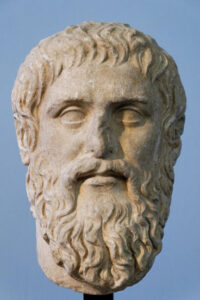
Plato outlined what nosotros know today as the quadrivium in his outline of the ideal pedagogy for a philosopher-male monarch. So, if you're looking for philosopher-king jobs, studying the 7 liberal arts is conspicuously the mode to get.
Plato sort of kicked off the whole 7 liberal arts matter by listing them as part of the core education offered in his Utopian work The Republic.
The 7 liberal arts contain the trivium and quadrivium: a set of 3 core skills, taught first, followed by 4 more avant-garde subjects.
Plato wasn't breaking new basis with the trivium; most well-educated Greeks would have pursued those studies in his era. The quadrivium were all subjects that were understood and taught broadly, equally well. Instead, Plato's innovation was in defining these subjects as not but the ideal for education in general, but equally a necessary part of educating what he referred to as the philosopher-king, an arcadian clarification of an individual who leads in club from a place of dearest and wisdom.
In Plato'south great work The Commonwealth, the philosopher-king was to study the 7 liberal arts for basically all of their lives, until age 50, to impart the wisdom and skills required to rule the Republic justly and maturely.
As democracy emerged, however, it before long became clear that every citizen was in office a king. Then equally the Romans embraced the ancient philosophies, they explicitly put the trivium and quadrivium together equally the appropriate manner of educational activity for all free and sovereign citizens of the Roman Commonwealth. In fact, the terms themselves are Latin, not Greek.
Trivium: Latin term for the meeting place of 3 roads.
Quadrivium: Latin term for the meeting place of 4 roads.
As the Western globe emerged from antiquity, the trivium and quadrivium were embraced by medieval scholars and universities as the ideal class of avant-garde educational activity. The trivium was the requisite class of study for available'south candidates, while the more avant-garde quadrivium formed the cadre of a chief's education.
Today, the 7 liberal arts have become many, but the roots laid by history continue to influence what you study in a liberal arts caste program.
The Trivium Invokes Arts of the Word
The basic education required to participate in society revolved around what take come to be chosen the arts of the word.
Grammar – This art encompassed studying written works and the forms of writing. This often happened through memorization and reading of classical texts. Learning and diagraming the parts of speech became common, and other language-related knowledge similar spelling and vocabulary take grown out of grammer studies.
Logic – Logic studies in the trivium were non the formal, mathematical courses that logic studies have become today, simply were instead rooted in dialectic: a discussion and investigation of truth and opinions. This is the root of today's liberal arts mainstay, word and seminar-style courses, equally well as the more formal fields of modern philosophy and logic.
Rhetoric – Rhetoric was closely associated with logic studies in the trivium, since it involved learning how to express opinions and make arguments in dialogue. It would also accept been a clear outgrowth of grammar studies, where students were expected to absorb, analyze, and discuss the arguments laid out in the classical works they were reading.
With these three basic tools of reasoning and expression, students were considered to be competent to go on to study other, more complex topics.
With the skills in dialogue and logic, students were equipped to reason their way in any other kind of field—a skill that is at the very heart of liberal arts.
The Quadrivium Teaches the Arts of Numbers
The quadrivium were the more avant-garde studies that students would take moved on to after mastering the trivium. These 4 subjects all revolve around math, leading to them existence called the arts of numbers.
Arithmetic – The basic operations of mathematics and numbers forms the basis for the other arts of the quadrivium. Addition, subtraction, multiplication, and partitioning, as well as mathematical annotation was studied.
Music – Musical studies are less widespread today beyond liberal arts, possibly because they have become more than specialized. Just in the original quadrivium, information technology was considered important that students empathise the forms and instruments of music, both for appreciation and creation. Today, music has broadened in to all types of artistic expression.
Geometry – Geometry in the quadrivium would have had far more than practical applications and studies than we associate with the term now. Withal those practical applications, in compages, surveying, and applied science, have emerged as their own dedicated disciplines and remain important core skills for liberal arts students today.
Astronomy – The contemplation of the heavens and humankind's place in them received more emphasis in an era where less was known and more was imagined than today. Astronomy was at first considered essential for fields such equally navigation and determining dates, merely grew to include more advanced mathematics and physics studies. These are natural sciences that are still important in liberal studies today.
Modern Reflections of The vii Liberal Arts in Liberal Studies Degrees
There are still some liberal arts degrees that focus on offer a classical education co-ordinate to the 7 liberal arts of the trivium and quadrivium. Most liberal studies majors take the ancient program of written report more as an inspiration than a format, notwithstanding.
You can encounter the incorporation of all of these subjects in educational programs right downwardly to the kindergarten level in mod Western social club. The 7 liberal arts have had a lasting impact on how nosotros retrieve nearly didactics and what it means to be educated.
In liberal studies caste programs, you'll detect that most of your cadre courses are outgrowths of the original 7 liberal arts. More than importantly, the style of learning reflects the kind of construction and dialog that was implicitly created by the trivium and quadrivium. All that was seen as of import to the creators of the 7 liberal arts remains important to liberal arts instructors today.
Groundwork in self-expression, critical assay, and rational research prepare students today for acquiring more than advanced knowledge. Nosotros accept a lot more than of that knowledge now than the Romans or even Medieval Europeans had, only much of information technology remains an outgrowth of their spirit of investigation and methods of logic and reason. It's truthful to such an extent that even in the vocational and professional degree programs of Western colleges, y'all'll still find required coursework in the 7 liberal arts and their descendants.


Post a Comment for "The Traditional Liberal Arts Education Included Rhetoric Biology Music Astronomy and Geometry"